
Note
Go to the end to download the full example code.
Custom converter with convert options#
This example shows how to write a custom sklearn converter whose behaviour
is controlled by a user-supplied ConvertOptionsProtocol
object.
The idea mirrors the built-in ConvertOptions
(decision_leaf, decision_path), but applied to a fully custom
estimator. The workflow has three steps:
Define the estimator — a plain scikit-learn transformer.
Define a custom options class — a lightweight object that implements the
ConvertOptionsProtocolprotocol (available_optionsandhas).Write the converter — a function that checks
g.convert_options.has("option_name", estimator)to decide whether to emit the optional extra output.
The custom estimator used here is ClipTransformer: it clips every feature
to a [clip_min, clip_max] range (equivalent to np.clip). The optional
extra output, activated by ClipOptions(clip_mask=True), is a boolean mask
tensor indicating which values were actually clipped.
import numpy as np
import onnxruntime
from sklearn.base import BaseEstimator, TransformerMixin

from yobx.doc import plot_dot
from yobx.helpers.onnx_helper import tensor_dtype_to_np_dtype
from yobx.sklearn import to_onnx
from yobx.typing import ConvertOptionsProtocol, GraphBuilderExtendedProtocol
1. Custom estimator: ClipTransformer#
A minimal transformer that clips all features into [clip_min, clip_max].
The helper method get_clip_mask returns a boolean array marking values
that were changed — it is used later to validate the ONNX output.
class ClipTransformer(TransformerMixin, BaseEstimator):
    """Clips every feature value to ``[clip_min, clip_max]``."""

    def __init__(self, clip_min: float = 0.0, clip_max: float = 1.0):
        self.clip_min = clip_min
        self.clip_max = clip_max

    def fit(self, X, y=None):
        return self

    def transform(self, X):
        return np.clip(X, self.clip_min, self.clip_max)

    def get_clip_mask(self, X):
        """Boolean mask: ``True`` where a value was clipped."""
        return (X < self.clip_min) | (X > self.clip_max)
2. Custom convert options: ClipOptions#
The options class must implement two methods:
available_options()— returns the list of option names the class recognises. The framework iterates this list to decide how many extra output slots to pre-allocate for each estimator.has(option_name, piece, name=None)— returnsTruewhen the option should be active for the given fitted estimator piece. The optional name is the pipeline step name (useful for enabling an option only for a specific named step in aPipeline).
class ClipOptions(ConvertOptionsProtocol):
    """Convert options for :class:`ClipTransformer`.

    :param clip_mask: when ``True``, adds a second boolean output tensor whose
        value is ``True`` at each position where the input was clipped.
    """

    def __init__(self, clip_mask: bool = False):
        self.clip_mask = clip_mask

    def available_options(self):
        """Returns the list of option names this class supports."""
        return ["clip_mask"]

    def has(self, option_name: str, piece: object, name=None) -> bool:
        """Returns ``True`` when *option_name* is active for *piece*."""
        if option_name == "clip_mask":
            # Only activate for estimators that have a clip_min attribute
            # (i.e. ClipTransformer instances).
            return bool(self.clip_mask) and hasattr(piece, "clip_min")
        return False
3. Converter function#
The converter always emits the primary Clip output (outputs[0]).
When g.convert_options.has("clip_mask", estimator) returns True the
framework has pre-allocated outputs[1] and the converter emits
Less + Greater + Or to fill it.
def convert_clip_transformer(
    g: GraphBuilderExtendedProtocol,
    sts: dict,
    outputs: list,
    estimator: ClipTransformer,
    X: str,
    name: str = "clip",
) -> str:
    """Convert :class:`ClipTransformer` to ONNX.

    Primary output
        ``outputs[0]`` — clipped values, same dtype and shape as *X*.

    Optional extra output (when ``ClipOptions(clip_mask=True)`` is used)
        ``outputs[1]`` — boolean mask, ``True`` where a value was clipped.
    """
    itype = g.get_type(X)
    dtype = tensor_dtype_to_np_dtype(itype)

    low = np.array(estimator.clip_min, dtype=dtype)
    high = np.array(estimator.clip_max, dtype=dtype)

    # ── Primary output: Clip ──────────────────────────────────────────────────
    _clipped = g.op.Clip(X, low, high, name=name, outputs=outputs[:1])

    # ── Optional extra output: clip mask ─────────────────────────────────────
    if g.convert_options.has("clip_mask", estimator, name):
        assert (
            len(outputs) > 1
        ), f"Expected at least 2 outputs when clip_mask is active, got {len(outputs)}"
        below = g.op.Less(X, low, name=f"{name}_below")
        above = g.op.Greater(X, high, name=f"{name}_above")
        g.op.Or(below, above, name=f"{name}_mask", outputs=outputs[1:2])

    return outputs[0] if len(outputs) == 1 else tuple(outputs)
4. Training data#
rng = np.random.default_rng(0)
X_train = rng.standard_normal((80, 4)).astype(np.float32)
X_test = rng.standard_normal((20, 4)).astype(np.float32)

transformer = ClipTransformer(clip_min=-0.5, clip_max=0.5).fit(X_train)
5. Baseline conversion — no extra output#
Without any convert_options the model produces a single output.
onx_plain = to_onnx(
    transformer, (X_train,), extra_converters={ClipTransformer: convert_clip_transformer}
)

print("=== Plain conversion (no clip_mask) ===")
print(f"Outputs: {[o.name for o in onx_plain.graph.output]}")

sess_plain = onnxruntime.InferenceSession(
    onx_plain.SerializeToString(), providers=["CPUExecutionProvider"]
)
(clipped_onnx,) = sess_plain.run(None, {"X": X_test})
clipped_sklearn = transformer.transform(X_test)

assert np.allclose(clipped_sklearn, clipped_onnx, atol=1e-6), "Clipped values differ!"
print("Clipped values match sklearn ✓")
=== Plain conversion (no clip_mask) ===
Outputs: ['Y']
Clipped values match sklearn ✓
6. Conversion with clip_mask=True#
Passing ClipOptions(clip_mask=True) instructs the framework to allocate
a second output slot. The converter detects this via
g.convert_options.has("clip_mask", estimator) and emits the boolean mask.
clip_opts = ClipOptions(clip_mask=True)
onx_with_mask = to_onnx(
    transformer,
    (X_train,),
    extra_converters={ClipTransformer: convert_clip_transformer},
    convert_options=clip_opts,
)

print("\n=== Conversion with clip_mask=True ===")
print(f"Outputs: {[o.name for o in onx_with_mask.graph.output]}")

sess_mask = onnxruntime.InferenceSession(
    onx_with_mask.SerializeToString(), providers=["CPUExecutionProvider"]
)
clipped_onnx2, mask_onnx = sess_mask.run(None, {"X": X_test})

# Verify clipped values
assert np.allclose(clipped_sklearn, clipped_onnx2, atol=1e-6), "Clipped values differ!"
print("Clipped values match sklearn ✓")

# Verify boolean mask
expected_mask = transformer.get_clip_mask(X_test)
assert np.array_equal(expected_mask, mask_onnx), "Clip mask differs!"
print("Clip mask matches sklearn ✓")

print(f"\nmask_onnx shape  : {mask_onnx.shape}")
print(f"fraction clipped : {mask_onnx.mean():.2%}")
=== Conversion with clip_mask=True ===
Outputs: ['Y', 'clip_mask']
Clipped values match sklearn ✓
Clip mask matches sklearn ✓

mask_onnx shape  : (20, 4)
fraction clipped : 57.50%
7. Visualize the ONNX graph#
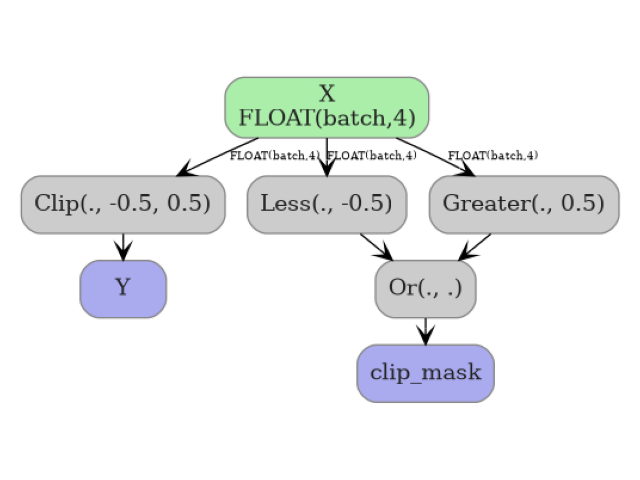
The graph with clip_mask=True contains the Clip node for the primary
output plus Less, Greater, and Or nodes for the mask.
plot_dot(onx_with_mask)
Total running time of the script: (0 minutes 0.186 seconds)
Related examples
Exporting sklearn tree models with convert options
Exporting sklearn estimators as ONNX local functions