
Note
Go to the end to download the full example code.
Decompose Einsum into Regular ONNX Operators#
The ONNX Einsum operator is very expressive but not all runtimes
support it. decompose_einsum converts an einsum
equation into a sub-graph built from simpler operators
(Transpose, Reshape, MatMul, Mul, ReduceSum, …)
that every compliant ONNX runtime understands.
The decomposition is implemented in yobx.helpers._einsum, a
self-contained sub-package — no external dependency is required.
import numpy as np
import onnxruntime
from yobx.doc import plot_dot
from yobx.helpers.einsum_helper import decompose_einsum
1. Matrix multiplication — ij,jk->ik#
The simplest useful einsum: multiply two 2-D matrices.
model_mm = decompose_einsum("ij,jk->ik", (3, 4), (4, 5))

# Validate the result numerically.
sess = onnxruntime.InferenceSession(
    model_mm.SerializeToString(), providers=["CPUExecutionProvider"]
)
a = np.random.rand(3, 4).astype(np.float32)
b = np.random.rand(4, 5).astype(np.float32)
(result,) = sess.run(None, {"X0": a, "X1": b})
expected = np.einsum("ij,jk->ik", a, b)
print("max |error|:", np.max(np.abs(result - expected)))
assert np.allclose(result, expected, atol=1e-5)
max |error|: 1.1920929e-07
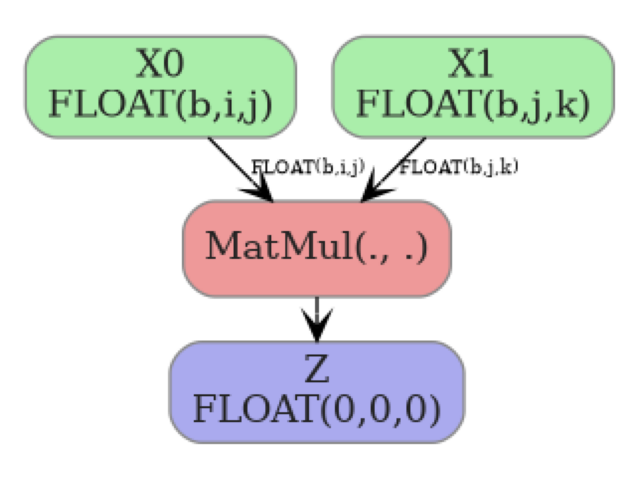
Graph of ij,jk->ik#
plot_dot() renders the decomposed ONNX graph so you can
see every node and edge at a glance.
plot_dot(model_mm)
2. Batched matrix multiplication — bij,bjk->bik#
A 3-D batched version of the matrix product.
model_bmm = decompose_einsum("bij,bjk->bik", (2, 3, 4), (2, 4, 5))

sess2 = onnxruntime.InferenceSession(
    model_bmm.SerializeToString(), providers=["CPUExecutionProvider"]
)
a = np.random.rand(2, 3, 4).astype(np.float32)
b = np.random.rand(2, 4, 5).astype(np.float32)
(result,) = sess2.run(None, {"X0": a, "X1": b})
expected = np.einsum("bij,bjk->bik", a, b)
print("max |error|:", np.max(np.abs(result - expected)))
assert np.allclose(result, expected, atol=1e-5)
max |error|: 2.3841858e-07
Graph of bij,bjk->bik#
plot_dot(model_bmm)
3. Three-operand contraction — bac,cd,def->ebc#
A more complex equation involving three input tensors.
model_3op = decompose_einsum("bac,cd,def->ebc", (2, 2, 2), (2, 2), (2, 2, 2))

sess3 = onnxruntime.InferenceSession(
    model_3op.SerializeToString(), providers=["CPUExecutionProvider"]
)
x0 = np.random.rand(2, 2, 2).astype(np.float32)
x1 = np.random.rand(2, 2).astype(np.float32)
x2 = np.random.rand(2, 2, 2).astype(np.float32)
(result,) = sess3.run(None, {"X0": x0, "X1": x1, "X2": x2})
expected = np.einsum("bac,cd,def->ebc", x0, x1, x2)
print("max |error|:", np.max(np.abs(result - expected)))
assert np.allclose(result, expected, atol=1e-5)
max |error|: 1.1920929e-07
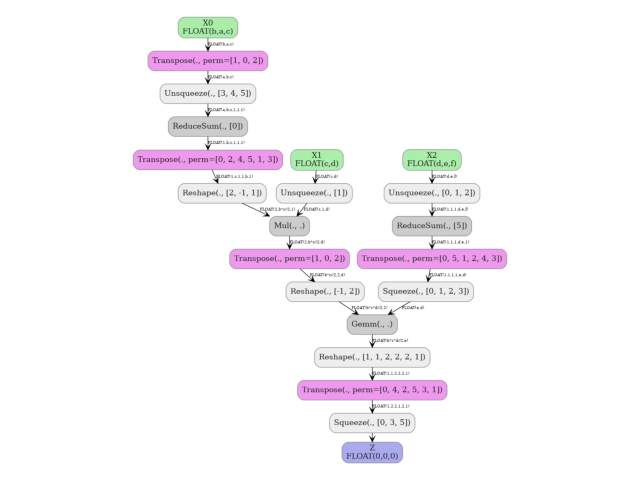
Graph of bac,cd,def->ebc#
plot_dot(model_3op)
Total running time of the script: (0 minutes 0.757 seconds)
Related examples
Comparing Computational Cost of Three Einsum→ONNX Strategies

ExtendedModelContainer: large-initializer ONNX models