Note
Go to the end to download the full example code.
TreeEnsemble, dense, and sparse
The example benchmarks the sparse implementation for TreeEnsemble. The default set of optimized parameters is very short and is meant to be executed fast. Many more parameters can be tried.
python plot_op_tree_ensemble_sparse --scenario=LONG
To change the training parameters:
python plot_op_tree_ensemble_sparse.py
    --n_trees=100
    --max_depth=10
    --n_features=50
    --sparsity=0.9
    --batch_size=100000
Another example with a full list of parameters:
- python plot_op_tree_ensemble_sparse.py
–n_trees=100 –max_depth=10 –n_features=50 –batch_size=100000 –sparsity=0.9 –tries=3 –scenario=CUSTOM –parallel_tree=80,40 –parallel_tree_N=128,64 –parallel_N=50,25 –batch_size_tree=1,2 –batch_size_rows=1,2 –use_node3=0
Another example:
python plot_op_tree_ensemble_sparse.py
    --n_trees=100 --n_features=10 --batch_size=10000 --max_depth=8 -s SHORT
import logging
import os
import timeit
from typing import Tuple
import numpy
import onnx
from onnx import ModelProto, TensorProto
from onnx.helper import make_graph, make_model, make_tensor_value_info
from pandas import DataFrame, concat
from sklearn.datasets import make_regression
from sklearn.ensemble import RandomForestRegressor
from skl2onnx import to_onnx
from onnxruntime import InferenceSession, SessionOptions
from onnx_array_api.plotting.text_plot import onnx_simple_text_plot
from onnx_extended.ortops.optim.cpu import get_ort_ext_libs
from onnx_extended.ortops.optim.optimize import (
    change_onnx_operator_domain,
    get_node_attribute,
    optimize_model,
)
from onnx_extended.tools.onnx_nodes import multiply_tree
from onnx_extended.validation.cpu._validation import dense_to_sparse_struct
from onnx_extended.plotting.benchmark import hhistograms
from onnx_extended.args import get_parsed_args
from onnx_extended.ext_test_case import unit_test_going

logging.getLogger("matplotlib.font_manager").setLevel(logging.ERROR)

script_args = get_parsed_args(
    "plot_op_tree_ensemble_sparse",
    description=__doc__,
    scenarios={
        "SHORT": "short optimization (default)",
        "LONG": "test more options",
        "CUSTOM": "use values specified by the command line",
    },
    sparsity=(0.99, "input sparsity"),
    n_features=(2 if unit_test_going() else 500, "number of features to generate"),
    n_trees=(3 if unit_test_going() else 10, "number of trees to train"),
    max_depth=(2 if unit_test_going() else 10, "max_depth"),
    batch_size=(100 if unit_test_going() else 1000, "batch size"),
    parallel_tree=("80,160,40", "values to try for parallel_tree"),
    parallel_tree_N=("256,128,64", "values to try for parallel_tree_N"),
    parallel_N=("100,50,25", "values to try for parallel_N"),
    batch_size_tree=("2,4,8", "values to try for batch_size_tree"),
    batch_size_rows=("2,4,8", "values to try for batch_size_rows"),
    use_node3=("0,1", "values to try for use_node3"),
    expose="",
    n_jobs=("-1", "number of jobs to train the RandomForestRegressor"),
)
Training a model
def train_model(
    batch_size: int, n_features: int, n_trees: int, max_depth: int, sparsity: float
) -> Tuple[str, numpy.ndarray, numpy.ndarray]:
    filename = (
        f"plot_op_tree_ensemble_sparse-f{n_features}-{n_trees}-"
        f"d{max_depth}-s{sparsity}.onnx"
    )
    if not os.path.exists(filename):
        X, y = make_regression(
            batch_size + max(batch_size, 2 ** (max_depth + 1)),
            n_features=n_features,
            n_targets=1,
        )
        mask = numpy.random.rand(*X.shape) <= sparsity
        X[mask] = 0
        X, y = X.astype(numpy.float32), y.astype(numpy.float32)

        print(f"Training to get {filename!r} with X.shape={X.shape}")
        # To be faster, we train only 1 tree.
        model = RandomForestRegressor(
            1, max_depth=max_depth, verbose=2, n_jobs=int(script_args.n_jobs)
        )
        model.fit(X[:-batch_size], y[:-batch_size])
        onx = to_onnx(model, X[:1], target_opset={"": 18, "ai.onnx.ml": 3})

        # And wd multiply the trees.
        node = multiply_tree(onx.graph.node[0], n_trees)
        onx = make_model(
            make_graph([node], onx.graph.name, onx.graph.input, onx.graph.output),
            domain=onx.domain,
            opset_imports=onx.opset_import,
            ir_version=onx.ir_version,
        )

        with open(filename, "wb") as f:
            f.write(onx.SerializeToString())
    else:
        X, y = make_regression(batch_size, n_features=n_features, n_targets=1)
        mask = numpy.random.rand(*X.shape) <= sparsity
        X[mask] = 0
        X, y = X.astype(numpy.float32), y.astype(numpy.float32)
    Xb, yb = X[-batch_size:].copy(), y[-batch_size:].copy()
    return filename, Xb, yb


def measure_sparsity(x):
    f = x.flatten()
    return float((f == 0).astype(numpy.int64).sum()) / float(x.size)


batch_size = script_args.batch_size
n_features = script_args.n_features
n_trees = script_args.n_trees
max_depth = script_args.max_depth
sparsity = script_args.sparsity

print(f"batch_size={batch_size}")
print(f"n_features={n_features}")
print(f"n_trees={n_trees}")
print(f"max_depth={max_depth}")
print(f"sparsity={sparsity}")
batch_size=1000
n_features=500
n_trees=10
max_depth=10
sparsity=0.99
training
Training to get 'plot_op_tree_ensemble_sparse-f500-10-d10-s0.99.onnx' with X.shape=(3048, 500)
[Parallel(n_jobs=-1)]: Using backend ThreadingBackend with 20 concurrent workers.
building tree 1 of 1
Xb.shape=(1000, 500)
yb.shape=(1000,)
measured sparsity=0.989862
Rewrite the onnx file to use a different kernel
The custom kernel is mapped to a custom operator with the same name the attributes and domain = “onnx_extended.ortops.optim.cpu”. We call a function to do that replacement. First the current model.
opset: domain='ai.onnx.ml' version=1
opset: domain='' version=18
opset: domain='' version=18
input: name='X' type=dtype('float32') shape=['', 500]
TreeEnsembleRegressor(X, n_targets=1, nodes_falsenodeids=670:[12,9,4...0,0,0], nodes_featureids=670:[481,481,291...372,176,0], nodes_hitrates=670:[1.0,1.0...1.0,1.0], nodes_missing_value_tracks_true=670:[0,0,0...0,0,0], nodes_modes=670:[b'BRANCH_LEQ',b'BRANCH_LEQ'...b'LEAF',b'LEAF'], nodes_nodeids=670:[0,1,2...64,65,66], nodes_treeids=670:[0,0,0...9,9,9], nodes_truenodeids=670:[1,2,3...0,0,0], nodes_values=670:[-0.375747948884964,-0.5223429203033447...-0.15301251411437988,0.0], post_transform=b'NONE', target_ids=340:[0,0,0...0,0,0], target_nodeids=340:[3,5,7...64,65,66], target_treeids=340:[0,0,0...9,9,9], target_weights=340:[370.132080078125,284.7577819824219...9.556397438049316,240.3916015625]) -> variable
output: name='variable' type=dtype('float32') shape=['', 1]
And then the modified model.
def transform_model(model, use_sparse=False, **kwargs):
    onx = ModelProto()
    onx.ParseFromString(model.SerializeToString())
    att = get_node_attribute(onx.graph.node[0], "nodes_modes")
    modes = ",".join([s.decode("ascii") for s in att.strings]).replace("BRANCH_", "")
    if use_sparse and "new_op_type" not in kwargs:
        kwargs["new_op_type"] = "TreeEnsembleRegressorSparse"
    if use_sparse:
        # with sparse tensor, missing value means 0
        att = get_node_attribute(onx.graph.node[0], "nodes_values")
        thresholds = numpy.array(att.floats, dtype=numpy.float32)
        missing_true = (thresholds >= 0).astype(numpy.int64)
        kwargs["nodes_missing_value_tracks_true"] = missing_true
    new_onx = change_onnx_operator_domain(
        onx,
        op_type="TreeEnsembleRegressor",
        op_domain="ai.onnx.ml",
        new_op_domain="onnx_extended.ortops.optim.cpu",
        nodes_modes=modes,
        **kwargs,
    )
    if use_sparse:
        del new_onx.graph.input[:]
        new_onx.graph.input.append(
            make_tensor_value_info("X", TensorProto.FLOAT, (None,))
        )
    return new_onx


print("Tranform model to add a custom node.")
onx_modified = transform_model(onx)
print(f"Save into {filename + 'modified.onnx'!r}.")
with open(filename + "modified.onnx", "wb") as f:
    f.write(onx_modified.SerializeToString())
print("done.")
print(onnx_simple_text_plot(onx_modified))
Tranform model to add a custom node.
Save into 'plot_op_tree_ensemble_sparse-f500-10-d10-s0.99.onnxmodified.onnx'.
done.
opset: domain='ai.onnx.ml' version=1
opset: domain='' version=18
opset: domain='' version=18
opset: domain='onnx_extended.ortops.optim.cpu' version=1
input: name='X' type=dtype('float32') shape=['', 500]
TreeEnsembleRegressor[onnx_extended.ortops.optim.cpu](X, nodes_modes=b'LEQ,LEQ,LEQ,LEAF,LEQ,LEAF,LEQ,LEAF,LEA...LEAF,LEAF', n_targets=1, nodes_falsenodeids=670:[12,9,4...0,0,0], nodes_featureids=670:[481,481,291...372,176,0], nodes_hitrates=670:[1.0,1.0...1.0,1.0], nodes_missing_value_tracks_true=670:[0,0,0...0,0,0], nodes_nodeids=670:[0,1,2...64,65,66], nodes_treeids=670:[0,0,0...9,9,9], nodes_truenodeids=670:[1,2,3...0,0,0], nodes_values=670:[-0.375747948884964,-0.5223429203033447...-0.15301251411437988,0.0], post_transform=b'NONE', target_ids=340:[0,0,0...0,0,0], target_nodeids=340:[3,5,7...64,65,66], target_treeids=340:[0,0,0...9,9,9], target_weights=340:[370.132080078125,284.7577819824219...9.556397438049316,240.3916015625]) -> variable
output: name='variable' type=dtype('float32') shape=['', 1]
Same with sparse.
print("Same transformation but with sparse.")
onx_modified_sparse = transform_model(onx, use_sparse=True)
print(f"Save into {filename + 'modified.sparse.onnx'!r}.")
with open(filename + "modified.sparse.onnx", "wb") as f:
    f.write(onx_modified_sparse.SerializeToString())
print("done.")
print(onnx_simple_text_plot(onx_modified_sparse))
Same transformation but with sparse.
Save into 'plot_op_tree_ensemble_sparse-f500-10-d10-s0.99.onnxmodified.sparse.onnx'.
done.
opset: domain='ai.onnx.ml' version=1
opset: domain='' version=18
opset: domain='' version=18
opset: domain='onnx_extended.ortops.optim.cpu' version=1
input: name='X' type=dtype('float32') shape=['']
TreeEnsembleRegressorSparse[onnx_extended.ortops.optim.cpu](X, nodes_missing_value_tracks_true=670:[0,0,0...1,0,1], nodes_modes=b'LEQ,LEQ,LEQ,LEAF,LEQ,LEAF,LEQ,LEAF,LEA...LEAF,LEAF', n_targets=1, nodes_falsenodeids=670:[12,9,4...0,0,0], nodes_featureids=670:[481,481,291...372,176,0], nodes_hitrates=670:[1.0,1.0...1.0,1.0], nodes_nodeids=670:[0,1,2...64,65,66], nodes_treeids=670:[0,0,0...9,9,9], nodes_truenodeids=670:[1,2,3...0,0,0], nodes_values=670:[-0.375747948884964,-0.5223429203033447...-0.15301251411437988,0.0], post_transform=b'NONE', target_ids=340:[0,0,0...0,0,0], target_nodeids=340:[3,5,7...64,65,66], target_treeids=340:[0,0,0...9,9,9], target_weights=340:[370.132080078125,284.7577819824219...9.556397438049316,240.3916015625]) -> variable
output: name='variable' type=dtype('float32') shape=['', 1]
Comparing onnxruntime and the custom kernel
print(f"Loading {filename!r}")
sess_ort = InferenceSession(filename, providers=["CPUExecutionProvider"])

r = get_ort_ext_libs()
print(f"Creating SessionOptions with {r!r}")
opts = SessionOptions()
if r is not None:
    opts.register_custom_ops_library(r[0])

print(f"Loading modified {filename!r}")
sess_cus = InferenceSession(
    onx_modified.SerializeToString(), opts, providers=["CPUExecutionProvider"]
)

print(f"Loading modified sparse {filename!r}")
sess_cus_sparse = InferenceSession(
    onx_modified_sparse.SerializeToString(), opts, providers=["CPUExecutionProvider"]
)


print(f"Running once with shape {Xb.shape}.")
base = sess_ort.run(None, {"X": Xb})[0]

print(f"Running modified with shape {Xb.shape}.")
got = sess_cus.run(None, {"X": Xb})[0]
print("done.")

Xb_sp = dense_to_sparse_struct(Xb)
print(f"Running modified sparse with shape {Xb_sp.shape}.")
got_sparse = sess_cus_sparse.run(None, {"X": Xb_sp})[0]
print("done.")
Loading 'plot_op_tree_ensemble_sparse-f500-10-d10-s0.99.onnx'
Creating SessionOptions with ['~/github/onnx-extended/onnx_extended/ortops/optim/cpu/libortops_optim_cpu.so']
Loading modified 'plot_op_tree_ensemble_sparse-f500-10-d10-s0.99.onnx'
Loading modified sparse 'plot_op_tree_ensemble_sparse-f500-10-d10-s0.99.onnx'
Running once with shape (1000, 500).
Running modified with shape (1000, 500).
done.
Running modified sparse with shape (10194,).
done.
Discrepancies?
Discrepancies: 0.00048828125
Discrepancies sparse: 0.00048828125
Simple verification
Baseline with onnxruntime.
t1 = timeit.timeit(lambda: sess_ort.run(None, {"X": Xb}), number=50)
print(f"baseline: {t1}")
baseline: 0.012465506995795295
The custom implementation.
t2 = timeit.timeit(lambda: sess_cus.run(None, {"X": Xb}), number=50)
print(f"new time: {t2}")
new time: 0.7285260650023702
The custom sparse implementation.
t3 = timeit.timeit(lambda: sess_cus_sparse.run(None, {"X": Xb_sp}), number=50)
print(f"new time sparse: {t3}")
new time sparse: 0.03934540900081629
Time for comparison
The custom kernel supports the same attributes as TreeEnsembleRegressor plus new ones to tune the parallelization. They can be seen in tree_ensemble.cc. Let’s try out many possibilities. The default values are the first ones.
if unit_test_going():
    optim_params = dict(
        parallel_tree=[40],  # default is 80
        parallel_tree_N=[128],  # default is 128
        parallel_N=[50, 25],  # default is 50
        batch_size_tree=[1],  # default is 1
        batch_size_rows=[1],  # default is 1
        use_node3=[0],  # default is 0
    )
elif script_args.scenario in (None, "SHORT"):
    optim_params = dict(
        parallel_tree=[80, 40],  # default is 80
        parallel_tree_N=[128, 64],  # default is 128
        parallel_N=[50, 25],  # default is 50
        batch_size_tree=[1],  # default is 1
        batch_size_rows=[1],  # default is 1
        use_node3=[0],  # default is 0
    )
elif script_args.scenario == "LONG":
    optim_params = dict(
        parallel_tree=[80, 160, 40],
        parallel_tree_N=[256, 128, 64],
        parallel_N=[100, 50, 25],
        batch_size_tree=[1, 2, 4, 8],
        batch_size_rows=[1, 2, 4, 8],
        use_node3=[0, 1],
    )
elif script_args.scenario == "CUSTOM":
    optim_params = dict(
        parallel_tree=[int(i) for i in script_args.parallel_tree.split(",")],
        parallel_tree_N=[int(i) for i in script_args.parallel_tree_N.split(",")],
        parallel_N=[int(i) for i in script_args.parallel_N.split(",")],
        batch_size_tree=[int(i) for i in script_args.batch_size_tree.split(",")],
        batch_size_rows=[int(i) for i in script_args.batch_size_rows.split(",")],
        use_node3=[int(i) for i in script_args.use_node3.split(",")],
    )
else:
    raise ValueError(
        f"Unknown scenario {script_args.scenario!r}, use --help to get them."
    )

cmds = []
for att, value in optim_params.items():
    cmds.append(f"--{att}={','.join(map(str, value))}")
print("Full list of optimization parameters:")
print(" ".join(cmds))
Full list of optimization parameters:
--parallel_tree=80,40 --parallel_tree_N=128,64 --parallel_N=50,25 --batch_size_tree=1 --batch_size_rows=1 --use_node3=0
Then the optimization for dense
def create_session(onx):
    opts = SessionOptions()
    r = get_ort_ext_libs()
    if r is None:
        raise RuntimeError("No custom implementation available.")
    opts.register_custom_ops_library(r[0])
    return InferenceSession(
        onx.SerializeToString(), opts, providers=["CPUExecutionProvider"]
    )


res = optimize_model(
    onx,
    feeds={"X": Xb},
    transform=transform_model,
    session=create_session,
    baseline=lambda onx: InferenceSession(
        onx.SerializeToString(), providers=["CPUExecutionProvider"]
    ),
    params=optim_params,
    verbose=True,
    number=script_args.number,
    repeat=script_args.repeat,
    warmup=script_args.warmup,
    sleep=script_args.sleep,
    n_tries=script_args.tries,
)
  0%|          | 0/16 [00:00<?, ?it/s]
i=1/16 TRY=0 //tree=80 //tree_N=128 //N=50 bs_tree=1 batch_size_rows=1 n3=0:   0%|          | 0/16 [00:00<?, ?it/s]
i=1/16 TRY=0 //tree=80 //tree_N=128 //N=50 bs_tree=1 batch_size_rows=1 n3=0:   6%|▋         | 1/16 [00:00<00:05,  2.61it/s]
i=2/16 TRY=0 //tree=80 //tree_N=128 //N=25 bs_tree=1 batch_size_rows=1 n3=0  ~=0.03x:   6%|▋         | 1/16 [00:00<00:05,  2.61it/s]
i=2/16 TRY=0 //tree=80 //tree_N=128 //N=25 bs_tree=1 batch_size_rows=1 n3=0  ~=0.03x:  12%|█▎        | 2/16 [00:00<00:03,  4.20it/s]
i=3/16 TRY=0 //tree=80 //tree_N=64 //N=50 bs_tree=1 batch_size_rows=1 n3=0  ~=0.35x:  12%|█▎        | 2/16 [00:00<00:03,  4.20it/s]
i=3/16 TRY=0 //tree=80 //tree_N=64 //N=50 bs_tree=1 batch_size_rows=1 n3=0  ~=0.35x:  19%|█▉        | 3/16 [00:00<00:02,  5.22it/s]
i=4/16 TRY=0 //tree=80 //tree_N=64 //N=25 bs_tree=1 batch_size_rows=1 n3=0  ~=0.97x:  19%|█▉        | 3/16 [00:00<00:02,  5.22it/s]
i=4/16 TRY=0 //tree=80 //tree_N=64 //N=25 bs_tree=1 batch_size_rows=1 n3=0  ~=0.97x:  25%|██▌       | 4/16 [00:00<00:02,  5.51it/s]
i=5/16 TRY=0 //tree=40 //tree_N=128 //N=50 bs_tree=1 batch_size_rows=1 n3=0  ~=0.97x:  25%|██▌       | 4/16 [00:00<00:02,  5.51it/s]
i=5/16 TRY=0 //tree=40 //tree_N=128 //N=50 bs_tree=1 batch_size_rows=1 n3=0  ~=0.97x:  31%|███▏      | 5/16 [00:01<00:02,  4.68it/s]
i=6/16 TRY=0 //tree=40 //tree_N=128 //N=25 bs_tree=1 batch_size_rows=1 n3=0  ~=0.97x:  31%|███▏      | 5/16 [00:01<00:02,  4.68it/s]
i=6/16 TRY=0 //tree=40 //tree_N=128 //N=25 bs_tree=1 batch_size_rows=1 n3=0  ~=0.97x:  38%|███▊      | 6/16 [00:01<00:01,  5.36it/s]
i=7/16 TRY=0 //tree=40 //tree_N=64 //N=50 bs_tree=1 batch_size_rows=1 n3=0  ~=0.97x:  38%|███▊      | 6/16 [00:01<00:01,  5.36it/s]
i=7/16 TRY=0 //tree=40 //tree_N=64 //N=50 bs_tree=1 batch_size_rows=1 n3=0  ~=0.97x:  44%|████▍     | 7/16 [00:01<00:01,  4.94it/s]
i=8/16 TRY=0 //tree=40 //tree_N=64 //N=25 bs_tree=1 batch_size_rows=1 n3=0  ~=0.97x:  44%|████▍     | 7/16 [00:01<00:01,  4.94it/s]
i=8/16 TRY=0 //tree=40 //tree_N=64 //N=25 bs_tree=1 batch_size_rows=1 n3=0  ~=0.97x:  50%|█████     | 8/16 [00:01<00:01,  4.66it/s]
i=9/16 TRY=1 //tree=80 //tree_N=128 //N=50 bs_tree=1 batch_size_rows=1 n3=0  ~=0.97x:  50%|█████     | 8/16 [00:01<00:01,  4.66it/s]
i=9/16 TRY=1 //tree=80 //tree_N=128 //N=50 bs_tree=1 batch_size_rows=1 n3=0  ~=0.97x:  56%|█████▋    | 9/16 [00:01<00:01,  5.21it/s]
i=10/16 TRY=1 //tree=80 //tree_N=128 //N=25 bs_tree=1 batch_size_rows=1 n3=0  ~=0.97x:  56%|█████▋    | 9/16 [00:01<00:01,  5.21it/s]
i=10/16 TRY=1 //tree=80 //tree_N=128 //N=25 bs_tree=1 batch_size_rows=1 n3=0  ~=0.97x:  62%|██████▎   | 10/16 [00:02<00:01,  5.21it/s]
i=11/16 TRY=1 //tree=80 //tree_N=64 //N=50 bs_tree=1 batch_size_rows=1 n3=0  ~=0.97x:  62%|██████▎   | 10/16 [00:02<00:01,  5.21it/s]
i=11/16 TRY=1 //tree=80 //tree_N=64 //N=50 bs_tree=1 batch_size_rows=1 n3=0  ~=0.97x:  69%|██████▉   | 11/16 [00:02<00:01,  3.49it/s]
i=12/16 TRY=1 //tree=80 //tree_N=64 //N=25 bs_tree=1 batch_size_rows=1 n3=0  ~=0.97x:  69%|██████▉   | 11/16 [00:02<00:01,  3.49it/s]
i=12/16 TRY=1 //tree=80 //tree_N=64 //N=25 bs_tree=1 batch_size_rows=1 n3=0  ~=0.97x:  75%|███████▌  | 12/16 [00:03<00:01,  2.80it/s]
i=13/16 TRY=1 //tree=40 //tree_N=128 //N=50 bs_tree=1 batch_size_rows=1 n3=0  ~=0.97x:  75%|███████▌  | 12/16 [00:03<00:01,  2.80it/s]
i=13/16 TRY=1 //tree=40 //tree_N=128 //N=50 bs_tree=1 batch_size_rows=1 n3=0  ~=0.97x:  81%|████████▏ | 13/16 [00:03<00:01,  2.84it/s]
i=14/16 TRY=1 //tree=40 //tree_N=128 //N=25 bs_tree=1 batch_size_rows=1 n3=0  ~=0.97x:  81%|████████▏ | 13/16 [00:03<00:01,  2.84it/s]
i=14/16 TRY=1 //tree=40 //tree_N=128 //N=25 bs_tree=1 batch_size_rows=1 n3=0  ~=0.97x:  88%|████████▊ | 14/16 [00:03<00:00,  2.83it/s]
i=15/16 TRY=1 //tree=40 //tree_N=64 //N=50 bs_tree=1 batch_size_rows=1 n3=0  ~=0.97x:  88%|████████▊ | 14/16 [00:03<00:00,  2.83it/s]
i=15/16 TRY=1 //tree=40 //tree_N=64 //N=50 bs_tree=1 batch_size_rows=1 n3=0  ~=0.97x:  94%|█████████▍| 15/16 [00:03<00:00,  3.40it/s]
i=16/16 TRY=1 //tree=40 //tree_N=64 //N=25 bs_tree=1 batch_size_rows=1 n3=0  ~=0.97x:  94%|█████████▍| 15/16 [00:03<00:00,  3.40it/s]
i=16/16 TRY=1 //tree=40 //tree_N=64 //N=25 bs_tree=1 batch_size_rows=1 n3=0  ~=0.97x: 100%|██████████| 16/16 [00:04<00:00,  2.79it/s]
i=16/16 TRY=1 //tree=40 //tree_N=64 //N=25 bs_tree=1 batch_size_rows=1 n3=0  ~=0.97x: 100%|██████████| 16/16 [00:04<00:00,  3.62it/s]
Then the optimization for sparse
res_sparse = optimize_model(
    onx,
    feeds={"X": Xb_sp},
    transform=lambda *args, **kwargs: transform_model(*args, use_sparse=True, **kwargs),
    session=create_session,
    params=optim_params,
    verbose=True,
    number=script_args.number,
    repeat=script_args.repeat,
    warmup=script_args.warmup,
    sleep=script_args.sleep,
    n_tries=script_args.tries,
)
  0%|          | 0/16 [00:00<?, ?it/s]
i=1/16 TRY=0 //tree=80 //tree_N=128 //N=50 bs_tree=1 batch_size_rows=1 n3=0:   0%|          | 0/16 [00:00<?, ?it/s]
i=1/16 TRY=0 //tree=80 //tree_N=128 //N=50 bs_tree=1 batch_size_rows=1 n3=0:   6%|▋         | 1/16 [00:00<00:01,  7.65it/s]
i=2/16 TRY=0 //tree=80 //tree_N=128 //N=25 bs_tree=1 batch_size_rows=1 n3=0:   6%|▋         | 1/16 [00:00<00:01,  7.65it/s]
i=2/16 TRY=0 //tree=80 //tree_N=128 //N=25 bs_tree=1 batch_size_rows=1 n3=0:  12%|█▎        | 2/16 [00:00<00:03,  4.22it/s]
i=3/16 TRY=0 //tree=80 //tree_N=64 //N=50 bs_tree=1 batch_size_rows=1 n3=0:  12%|█▎        | 2/16 [00:00<00:03,  4.22it/s]
i=3/16 TRY=0 //tree=80 //tree_N=64 //N=50 bs_tree=1 batch_size_rows=1 n3=0:  19%|█▉        | 3/16 [00:00<00:02,  4.65it/s]
i=4/16 TRY=0 //tree=80 //tree_N=64 //N=25 bs_tree=1 batch_size_rows=1 n3=0:  19%|█▉        | 3/16 [00:00<00:02,  4.65it/s]
i=4/16 TRY=0 //tree=80 //tree_N=64 //N=25 bs_tree=1 batch_size_rows=1 n3=0:  25%|██▌       | 4/16 [00:00<00:03,  3.80it/s]
i=5/16 TRY=0 //tree=40 //tree_N=128 //N=50 bs_tree=1 batch_size_rows=1 n3=0:  25%|██▌       | 4/16 [00:00<00:03,  3.80it/s]
i=5/16 TRY=0 //tree=40 //tree_N=128 //N=50 bs_tree=1 batch_size_rows=1 n3=0:  31%|███▏      | 5/16 [00:01<00:03,  3.59it/s]
i=6/16 TRY=0 //tree=40 //tree_N=128 //N=25 bs_tree=1 batch_size_rows=1 n3=0:  31%|███▏      | 5/16 [00:01<00:03,  3.59it/s]
i=6/16 TRY=0 //tree=40 //tree_N=128 //N=25 bs_tree=1 batch_size_rows=1 n3=0:  38%|███▊      | 6/16 [00:01<00:02,  3.99it/s]
i=7/16 TRY=0 //tree=40 //tree_N=64 //N=50 bs_tree=1 batch_size_rows=1 n3=0:  38%|███▊      | 6/16 [00:01<00:02,  3.99it/s]
i=7/16 TRY=0 //tree=40 //tree_N=64 //N=50 bs_tree=1 batch_size_rows=1 n3=0:  44%|████▍     | 7/16 [00:01<00:02,  4.41it/s]
i=8/16 TRY=0 //tree=40 //tree_N=64 //N=25 bs_tree=1 batch_size_rows=1 n3=0:  44%|████▍     | 7/16 [00:01<00:02,  4.41it/s]
i=8/16 TRY=0 //tree=40 //tree_N=64 //N=25 bs_tree=1 batch_size_rows=1 n3=0:  50%|█████     | 8/16 [00:01<00:02,  3.96it/s]
i=9/16 TRY=1 //tree=80 //tree_N=128 //N=50 bs_tree=1 batch_size_rows=1 n3=0:  50%|█████     | 8/16 [00:01<00:02,  3.96it/s]
i=9/16 TRY=1 //tree=80 //tree_N=128 //N=50 bs_tree=1 batch_size_rows=1 n3=0:  56%|█████▋    | 9/16 [00:02<00:02,  2.98it/s]
i=10/16 TRY=1 //tree=80 //tree_N=128 //N=25 bs_tree=1 batch_size_rows=1 n3=0:  56%|█████▋    | 9/16 [00:02<00:02,  2.98it/s]
i=10/16 TRY=1 //tree=80 //tree_N=128 //N=25 bs_tree=1 batch_size_rows=1 n3=0:  62%|██████▎   | 10/16 [00:02<00:02,  2.57it/s]
i=11/16 TRY=1 //tree=80 //tree_N=64 //N=50 bs_tree=1 batch_size_rows=1 n3=0:  62%|██████▎   | 10/16 [00:02<00:02,  2.57it/s]
i=11/16 TRY=1 //tree=80 //tree_N=64 //N=50 bs_tree=1 batch_size_rows=1 n3=0:  69%|██████▉   | 11/16 [00:03<00:02,  2.32it/s]
i=12/16 TRY=1 //tree=80 //tree_N=64 //N=25 bs_tree=1 batch_size_rows=1 n3=0:  69%|██████▉   | 11/16 [00:03<00:02,  2.32it/s]
i=12/16 TRY=1 //tree=80 //tree_N=64 //N=25 bs_tree=1 batch_size_rows=1 n3=0:  75%|███████▌  | 12/16 [00:03<00:01,  2.45it/s]
i=13/16 TRY=1 //tree=40 //tree_N=128 //N=50 bs_tree=1 batch_size_rows=1 n3=0:  75%|███████▌  | 12/16 [00:03<00:01,  2.45it/s]
i=13/16 TRY=1 //tree=40 //tree_N=128 //N=50 bs_tree=1 batch_size_rows=1 n3=0:  81%|████████▏ | 13/16 [00:04<00:01,  2.62it/s]
i=14/16 TRY=1 //tree=40 //tree_N=128 //N=25 bs_tree=1 batch_size_rows=1 n3=0:  81%|████████▏ | 13/16 [00:04<00:01,  2.62it/s]
i=14/16 TRY=1 //tree=40 //tree_N=128 //N=25 bs_tree=1 batch_size_rows=1 n3=0:  88%|████████▊ | 14/16 [00:04<00:00,  2.45it/s]
i=15/16 TRY=1 //tree=40 //tree_N=64 //N=50 bs_tree=1 batch_size_rows=1 n3=0:  88%|████████▊ | 14/16 [00:04<00:00,  2.45it/s]
i=15/16 TRY=1 //tree=40 //tree_N=64 //N=50 bs_tree=1 batch_size_rows=1 n3=0:  94%|█████████▍| 15/16 [00:05<00:00,  2.33it/s]
i=16/16 TRY=1 //tree=40 //tree_N=64 //N=25 bs_tree=1 batch_size_rows=1 n3=0:  94%|█████████▍| 15/16 [00:05<00:00,  2.33it/s]
i=16/16 TRY=1 //tree=40 //tree_N=64 //N=25 bs_tree=1 batch_size_rows=1 n3=0: 100%|██████████| 16/16 [00:05<00:00,  2.23it/s]
i=16/16 TRY=1 //tree=40 //tree_N=64 //N=25 bs_tree=1 batch_size_rows=1 n3=0: 100%|██████████| 16/16 [00:05<00:00,  2.84it/s]
And the results.
df_dense = DataFrame(res)
df_dense["input"] = "dense"
df_sparse = DataFrame(res_sparse)
df_sparse["input"] = "sparse"
df = concat([df_dense, df_sparse], axis=0)
df.to_csv("plot_op_tree_ensemble_sparse.csv", index=False)
df.to_excel("plot_op_tree_ensemble_sparse.xlsx", index=False)
print(df.columns)
print(df.head(5))
Index(['average', 'deviation', 'min_exec', 'max_exec', 'repeat', 'number',
       'ttime', 'context_size', 'warmup_time', 'n_exp', 'n_exp_name',
       'short_name', 'TRY', 'name', 'parallel_tree', 'parallel_tree_N',
       'parallel_N', 'batch_size_tree', 'batch_size_rows', 'use_node3',
       'input'],
      dtype='object')
    average  deviation  min_exec  max_exec  repeat  number     ttime  context_size  warmup_time  n_exp  ...         short_name  TRY             name parallel_tree  parallel_tree_N  parallel_N  batch_size_tree  batch_size_rows  use_node3  input
0  0.000040   0.000019  0.000029  0.000094      10      10  0.000396            64     0.000622      0  ...         0,baseline  0.0         baseline           NaN              NaN         NaN              NaN              NaN        NaN  dense
1  0.001217   0.001955  0.000045  0.005543      10      10  0.012173            64     0.040931      0  ...  0,80,128,50,1,1,0  NaN  80,128,50,1,1,0          80.0            128.0        50.0              1.0              1.0        0.0  dense
2  0.000112   0.000157  0.000029  0.000553      10      10  0.001122            64     0.009048      1  ...  0,80,128,25,1,1,0  NaN  80,128,25,1,1,0          80.0            128.0        25.0              1.0              1.0        0.0  dense
3  0.000041   0.000020  0.000029  0.000099      10      10  0.000407            64     0.017286      2  ...   0,80,64,50,1,1,0  NaN   80,64,50,1,1,0          80.0             64.0        50.0              1.0              1.0        0.0  dense
4  0.000167   0.000275  0.000042  0.000978      10      10  0.001665            64     0.034604      3  ...   0,80,64,25,1,1,0  NaN   80,64,25,1,1,0          80.0             64.0        25.0              1.0              1.0        0.0  dense

[5 rows x 21 columns]
Sorting
small_df = df.drop(
    [
        "min_exec",
        "max_exec",
        "repeat",
        "number",
        "context_size",
        "n_exp_name",
    ],
    axis=1,
).sort_values("average")
print(small_df.head(n=10))
     average  deviation     ttime  warmup_time  n_exp         short_name  TRY             name  parallel_tree  parallel_tree_N  parallel_N  batch_size_tree  batch_size_rows  use_node3   input
17  0.000029   0.000002  0.000286     0.000352      0         1,baseline  1.0         baseline            NaN              NaN         NaN              NaN              NaN        NaN   dense
0   0.000040   0.000019  0.000396     0.000622      0         0,baseline  0.0         baseline            NaN              NaN         NaN              NaN              NaN        NaN   dense
3   0.000041   0.000020  0.000407     0.017286      2   0,80,64,50,1,1,0  NaN   80,64,50,1,1,0           80.0             64.0        50.0              1.0              1.0        0.0   dense
6   0.000070   0.000054  0.000697     0.016966      5  0,40,128,25,1,1,0  NaN  40,128,25,1,1,0           40.0            128.0        25.0              1.0              1.0        0.0   dense
2   0.000112   0.000157  0.001122     0.009048      1  0,80,128,25,1,1,0  NaN  80,128,25,1,1,0           80.0            128.0        25.0              1.0              1.0        0.0   dense
4   0.000167   0.000275  0.001665     0.034604      3   0,80,64,25,1,1,0  NaN   80,64,25,1,1,0           80.0             64.0        25.0              1.0              1.0        0.0   dense
15  0.000174   0.000201  0.001736     0.020631     14   1,40,64,50,1,1,0  NaN   40,64,50,1,1,0           40.0             64.0        50.0              1.0              1.0        0.0   dense
0   0.000235   0.000202  0.002354     0.002856      0  0,80,128,50,1,1,0  NaN  80,128,50,1,1,0           80.0            128.0        50.0              1.0              1.0        0.0  sparse
9   0.000256   0.000317  0.002559     0.004572      8  1,80,128,50,1,1,0  NaN  80,128,50,1,1,0           80.0            128.0        50.0              1.0              1.0        0.0   dense
2   0.000407   0.000406  0.004069     0.035313      2   0,80,64,50,1,1,0  NaN   80,64,50,1,1,0           80.0             64.0        50.0              1.0              1.0        0.0  sparse
Worst
print(small_df.tail(n=10))
     average  deviation     ttime  warmup_time  n_exp         short_name  TRY             name  parallel_tree  parallel_tree_N  parallel_N  batch_size_tree  batch_size_rows  use_node3   input
14  0.001905   0.002785  0.019049     0.046875     13  1,40,128,25,1,1,0  NaN  40,128,25,1,1,0           40.0            128.0        25.0              1.0              1.0        0.0   dense
13  0.003120   0.004085  0.031196     0.038807     13  1,40,128,25,1,1,0  NaN  40,128,25,1,1,0           40.0            128.0        25.0              1.0              1.0        0.0  sparse
14  0.003204   0.004236  0.032044     0.046910     14   1,40,64,50,1,1,0  NaN   40,64,50,1,1,0           40.0             64.0        50.0              1.0              1.0        0.0  sparse
15  0.003225   0.003658  0.032253     0.053248     15   1,40,64,25,1,1,0  NaN   40,64,25,1,1,0           40.0             64.0        25.0              1.0              1.0        0.0  sparse
11  0.003364   0.003568  0.033635     0.050799     10   1,80,64,50,1,1,0  NaN   80,64,50,1,1,0           80.0             64.0        50.0              1.0              1.0        0.0   dense
16  0.003402   0.003926  0.034017     0.047313     15   1,40,64,25,1,1,0  NaN   40,64,25,1,1,0           40.0             64.0        25.0              1.0              1.0        0.0   dense
12  0.003402   0.005114  0.034022     0.062682     11   1,80,64,25,1,1,0  NaN   80,64,25,1,1,0           80.0             64.0        25.0              1.0              1.0        0.0   dense
8   0.003405   0.003623  0.034051     0.062638      8  1,80,128,50,1,1,0  NaN  80,128,50,1,1,0           80.0            128.0        50.0              1.0              1.0        0.0  sparse
9   0.003487   0.004067  0.034868     0.047035      9  1,80,128,25,1,1,0  NaN  80,128,25,1,1,0           80.0            128.0        25.0              1.0              1.0        0.0  sparse
10  0.003767   0.004279  0.037670     0.042568     10   1,80,64,50,1,1,0  NaN   80,64,50,1,1,0           80.0             64.0        50.0              1.0              1.0        0.0  sparse
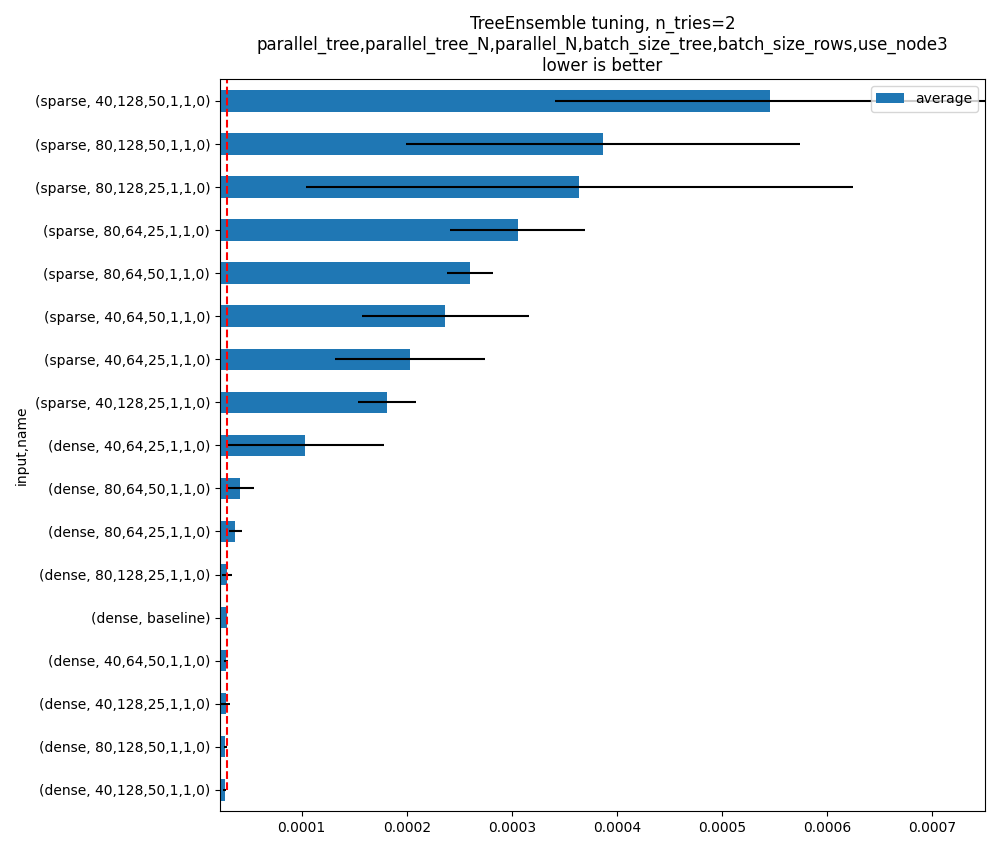
Plot
skeys = ",".join(optim_params.keys())
title = f"TreeEnsemble tuning, n_tries={script_args.tries}\n{skeys}\nlower is better"
ax = hhistograms(df, title=title, keys=("input", "name"))
fig = ax.get_figure()
fig.savefig("plot_op_tree_ensemble_sparse.png")
Total running time of the script: (0 minutes 11.613 seconds)