Using sklearn-onnx to convert any scikit-learn estimator#

yobx.sklearn.to_onnx() ships with built-in converters for a curated set of scikit-learn estimators (StandardScaler, LogisticRegression, DecisionTree*, MLP*, and Pipeline). For any estimator that is not covered by the built-in registry, you can supply your own converter through the extra_converters keyword argument.

This example shows how to write such a custom converter for MLPClassifier using sklearn-onnx (skl2onnx) as the conversion back-end. The approach generalises to any scikit-learn estimator that skl2onnx supports.

The strategy#

  1. Call skl2onnx.convert_sklearn() to obtain a self-contained onnx.ModelProto for the estimator alone.

  2. Wrap that sub-model as a local ONNX function inside the enclosing GraphBuilder using FunctionOptions. The function groups the MLP nodes under a single named call during graph construction, and its weight tensors are stored as Constant nodes inside the function body rather than as top-level graph initializers.

  3. Emit a make_node call for the freshly registered function so the MLP plugs into the rest of the pipeline graph.

The yobx optimizer (invoked by yobx.sklearn.to_onnx() at export time) inlines local functions into the enclosing graph, so the final onnx.ModelProto contains the individual MatMul, Add, Relu, and Sigmoid nodes rather than a single call-node. The local-function wrapping is therefore a construction-time organisational pattern that keeps converter code clean and composable even when the emitted sub-graph is ultimately inlined.

from typing import Dict, List, Tuple

import numpy as np
import onnx
import onnxruntime
from sklearn.neural_network import MLPClassifier
from skl2onnx import convert_sklearn
from skl2onnx.common.data_types import DoubleTensorType, FloatTensorType

from yobx import doc
from yobx.typing import GraphBuilderExtendedProtocol
from yobx.xbuilder import FunctionOptions
from yobx.sklearn import to_onnx

Helper: map ONNX element type to a skl2onnx input-type descriptor#

skl2onnx.convert_sklearn() requires an initial_types list that describes the shape and dtype of each model input using skl2onnx type objects such as FloatTensorType. The helper below translates an ONNX elem_type integer (as returned by get_type()) into the matching skl2onnx descriptor.

def to_skl2onnx_input_type(elem_type: int, n_features: int):
    """
    Convert an ONNX ``TensorProto`` element-type code into the matching
    :epkg:`sklearn-onnx` input-type object.

    :param elem_type: ONNX element type integer (e.g.
        ``onnx.TensorProto.FLOAT == 1``).
    :param n_features: number of input features (second dimension of the
        2-D feature matrix).
    :return: a skl2onnx type descriptor suitable for ``initial_types``.
    :raises NotImplementedError: for element types other than ``FLOAT``
        and ``DOUBLE``.
    """
    if elem_type == onnx.TensorProto.FLOAT:
        return FloatTensorType([None, n_features])
    if elem_type == onnx.TensorProto.DOUBLE:
        return DoubleTensorType([None, n_features])
    raise NotImplementedError(
        f"Input elem_type {elem_type} is not supported. "
        "Only FLOAT (1) and DOUBLE (11) are supported by the skl2onnx MLP converter."
    )

Custom converter: MLPClassifier via skl2onnx + local function#

A yobx converter is a plain Python function that receives the active GraphBuilder, a shape-tracking dict (sts), the desired output tensor names, the fitted estimator, and the name of the input tensor already present in the graph. It must emit all necessary ONNX nodes into g and return the name(s) of the produced output tensors.

Here we implement this contract by:

  1. Asking skl2onnx to convert the estimator to a stand-alone ONNX model (zipmap=False so probabilities come out as a plain float tensor instead of a sequence-of-maps).

  2. Fixing the opset version in the generated model to match the opset already in use by the enclosing graph — skl2onnx may pick a lower version than the one we need.

  3. Loading the generated model into a temporary GraphBuilder, then registering it as a local ONNX function in the enclosing graph via FunctionOptions.

  4. Emitting a single call-node for that function.

def convert_sklearn_mlp_classifier(
    g: GraphBuilderExtendedProtocol,
    sts: Dict,
    outputs: List[str],
    estimator: MLPClassifier,
    X: str,
    name: str = "mlp_classifier",
) -> Tuple[str, str]:
    """
    Convert a fitted :class:`~sklearn.neural_network.MLPClassifier` into
    ONNX nodes inside an existing :class:`~yobx.xbuilder.GraphBuilder`.

    The conversion delegates to :func:`skl2onnx.convert_sklearn` for the
    actual graph construction, wraps the result in a local ONNX function
    to keep the converter code composable, and emits a single call-node
    for that function.  The yobx optimizer will inline the function when
    :func:`~yobx.sklearn.to_onnx` finalises the model.

    :param g: the :class:`~yobx.xbuilder.GraphBuilder` that is currently
        being populated.
    :param sts: shape-tracking dictionary populated by the yobx converter
        framework (passed through unchanged).
    :param outputs: list of desired output tensor names
        ``[label, probabilities]``.
    :param estimator: a fitted ``MLPClassifier`` instance.
    :param X: name of the input tensor already present in *g*.
    :param name: base name used for the emitted call-node.
    :return: tuple ``(label_name, probabilities_name)`` — the names of the
        two output tensors in *g*.
    """
    assert isinstance(
        estimator, MLPClassifier
    ), f"Unexpected type {type(estimator)} for estimator."
    assert g.has_type(X), f"Missing type for {X!r}{g.get_debug_msg()}"

    itype = g.get_type(X)
    n_features = estimator.coefs_[0].shape[0]

    # Step 1 — obtain a stand-alone ONNX model from skl2onnx.
    # ``zipmap=False`` makes the probability output a plain [N, n_classes]
    # float tensor instead of the default sequence-of-maps representation.
    onx = convert_sklearn(
        estimator,
        initial_types=[("X", to_skl2onnx_input_type(itype, n_features))],
        options={"zipmap": False},
        target_opset=g.main_opset,
    )

    # Step 2 — normalise the opset version.
    # skl2onnx may select a lower opset than the one required by the
    # enclosing graph (it picks the lowest version whose op-set covers
    # every node it emitted).  Overwrite it so the sub-model is compatible.
    del onx.opset_import[:]
    d = onx.opset_import.add()
    d.domain = ""
    d.version = g.main_opset

    # Step 3 — load the sub-model into a temporary GraphBuilder, then
    # register it as a local ONNX function inside *g*.
    # ``move_initializer_to_constant=True`` converts weight initializers
    # into ``Constant`` nodes so they travel with the function definition
    # rather than being stored as top-level graph initializers.
    builder = g.__class__(onx)
    f_options = FunctionOptions(
        export_as_function=True,
        name=g.unique_function_name("MLPClassifier"),
        domain="sklearn_onnx_functions",
        move_initializer_to_constant=True,
    )
    g.make_local_function(builder, f_options)

    # Step 4 — emit a single call-node for the registered function.
    return g.make_node(f_options.name, [X], outputs, domain=f_options.domain, name=name)

1. Train a simple MLPClassifier#

We use a tiny dataset (four samples, two features, binary labels) so the example runs instantly. The same API works for larger datasets and deeper networks.

X = np.array([[1, 2], [3, 4], [5, 6], [7, 8]], dtype=np.float32)
y = np.array([0, 0, 1, 1])
mlp = MLPClassifier(hidden_layer_sizes=(4,), activation="relu", random_state=0, max_iter=2000)
mlp.fit(X, y)

print("MLPClassifier architecture:")
print(f"  hidden layers : {mlp.hidden_layer_sizes}")
print(f"  activation    : {mlp.activation}")
print(f"  n_layers_     : {mlp.n_layers_}")
MLPClassifier architecture:
  hidden layers : (4,)
  activation    : relu
  n_layers_     : 3

2. Convert to ONNX using the custom converter#

We pass our custom converter function through extra_converters. The yobx framework will call it whenever it encounters an MLPClassifier instance while traversing the estimator (or pipeline).

onx = to_onnx(mlp, (X,), extra_converters={MLPClassifier: convert_sklearn_mlp_classifier})

print("\nTop-level graph nodes:")
for node in onx.graph.node:
    print(f"  op_type={node.op_type!r}  domain={node.domain!r}  name={node.name!r}")

print("\nLocal functions defined in the model:")
for func in onx.functions:
    print(f"  {func.domain}::{func.name}  ({len(func.node)} nodes)")
Top-level graph nodes:
  op_type='MatMul'  domain=''  name='MatMul'
  op_type='Add'  domain=''  name='Add'
  op_type='Relu'  domain=''  name='Relu'
  op_type='MatMul'  domain=''  name='MatMul1'
  op_type='Add'  domain=''  name='Add1'
  op_type='Sigmoid'  domain=''  name='Relu1'
  op_type='Sub'  domain=''  name='Sub'
  op_type='Concat'  domain=''  name='Concat'
  op_type='ArgMax'  domain=''  name='ArgMax'
  op_type='ArrayFeatureExtractor'  domain='ai.onnx.ml'  name='ArrayFeatureExtractor'
  op_type='Reshape'  domain=''  name='Reshape'
  op_type='Cast'  domain=''  name='Cast1'

Local functions defined in the model:

3. Run with ONNX Runtime and verify#

We execute the exported model with onnxruntime and compare its predictions to scikit-learn’s. Both the class labels and the class-probability matrix must match within floating-point tolerance.

ref = onnxruntime.InferenceSession(onx.SerializeToString(), providers=["CPUExecutionProvider"])
results = ref.run(None, {"X": X})
label_onnx, proba_onnx = results[0], results[1]

label_sk = mlp.predict(X)
proba_sk = mlp.predict_proba(X)

print("\nPredicted labels  (sklearn):", label_sk)
print("Predicted labels  (ONNX)   :", label_onnx)

np.testing.assert_array_equal(label_sk, label_onnx)
np.testing.assert_allclose(proba_sk, proba_onnx, atol=1e-5)
print("\nAll predictions match ✓")
Predicted labels  (sklearn): [0 0 1 1]
Predicted labels  (ONNX)   : [0 0 1 1]

All predictions match ✓

4. Visualise the exported ONNX graph#

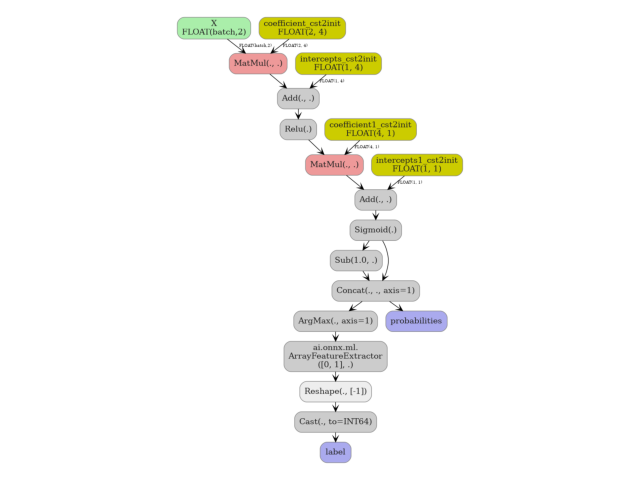
yobx.doc.plot_dot() renders the onnx.ModelProto as a directed graph using Graphviz. The yobx optimizer inlines the local function during export, so the graph shows the individual MatMul, Add, Relu, and Sigmoid nodes that make up the MLP rather than a single call-node.

doc.plot_dot(onx)
plot sklearn with sklearn onnx

Total running time of the script: (0 minutes 0.923 seconds)

Related examples

Converting a scikit-learn Pipeline to ONNX

Converting a scikit-learn Pipeline to ONNX

Converting a scikit-learn model to ONNX with spox

Converting a scikit-learn model to ONNX with spox

Exporting sklearn estimators as ONNX local functions

Exporting sklearn estimators as ONNX local functions

Gallery generated by Sphinx-Gallery